
Blog
What That Noise Your Garage Door Is Making Actually Means
La Crosse homes built between 1967 and 1998 carry original track and spring hardware that reacts hard to our cold-severe winters. Here's what the noise is actually telling you.
What Local Conditions Do
Most of the housing stock in this service area went up between 1967 and 1998, with the median landing around 1979. That matters more than people think, because a door and track system installed in the Carter or Reagan years was built for a different set of expectations than what gets sold today. On top of that, La Crosse sits in a cold-severe climate band. Steel track and galvanized hardware contract hard in deep cold and expand again every spring thaw, year after year. A bracket that was torqued down tight in 1981 has been through forty-plus of those cycles. Bolts work loose. Brackets bend a few degrees off true. Rollers that were fine at install start binding because the track they ride in isn't quite the shape it used to be. None of this is a defect - it's just what cold-severe winters do to hardware that's been in the wall that long. The noise you hear isn't random. It's the sound of metal that's been flexed thousands of times telling you where it's given up a little ground. In a newer climate zone, the same door might run quiet for another decade. Here, it doesn't.
The Situation
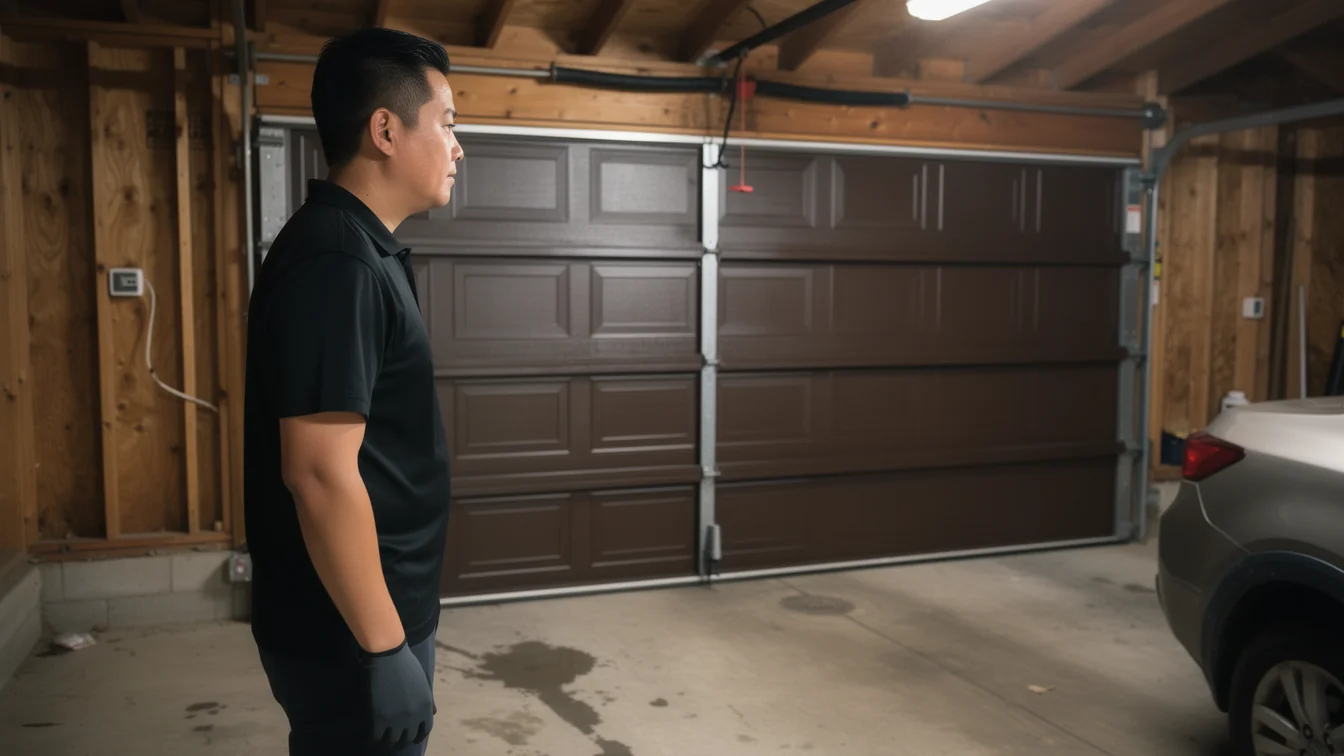
On a lot of the doors we look at in houses from the 1967-1998 era, the noise traces back to one of three places. First, the original rollers - steel or early nylon, now dry and out of round, grinding every time they pass a bent track section. Second, the hinges between panels, which loosen as the cold-severe swings work the screw holes in the panel steel wider than they started. Third, and this is the one that worries people most, a torsion spring that's lost tension gradually enough that the opener has been quietly overworking to compensate - that shows up as a groan or a bang at the top of the travel, not a smooth hum. Which one you've got depends on which part of the door is making the sound and when in the cycle it happens. A squeal the whole way up usually points to rollers. A thud near the top points to springs or cable. A rattle that's loudest when it's below freezing outside points to contracted hardware working against itself. We can usually narrow it down over the phone if you can tell us where in the door's travel the noise happens, but a look at the actual track and spring tells us more than guessing ever will.
The Cost of This Job
We're not going to quote a number here that isn't tied to your actual door, because that's not something we have good data on in a general sense, and a made-up figure is worse than no figure. What we can tell you is how the decision usually breaks down. With roughly 16,000 owner-occupied houses in this service area and a median household income around $77,083, most of the calls we get aren't people replacing a door outright - they're people keeping a door from the 1970s, 80s, or 90s running another several years. Roller replacement and hinge tightening are small jobs. A spring replacement is a bigger one, priced by spring size and door weight, not by a flat rate. Track realignment falls somewhere in between depending on how far out of true the cold cycles have pushed it. The honest limitation: if your door's bottom panel is rusted through or the track is bent badly enough that it's been forced back into shape more than once, repair stops being the cheaper option and we'll tell you that rather than keep patching it.
Leaving It Alone
A noisy door in a house from this era rarely fixes itself, and cold-severe winters don't give worn hardware a break to recover. What starts as a squeal from a dry roller becomes a roller that seizes mid-track, which puts load on the opener and the cable it wasn't built to carry. A loose hinge left alone works its screw holes wider every winter until the panel itself needs replacing instead of the hinge. The one that matters most is the spring. A torsion spring that's lost tension doesn't usually fail gently - it fails at the moment of most load, which is often when someone's hand or foot is near the door. We're not saying every noise is urgent. A lot of what we hear out is cosmetic and can wait for a scheduled visit. But in houses built in the 1967-1998 range, where the original hardware has already been through decades of cold-severe cycling, the margin between annoying and unsafe is thinner than people assume. If the noise changed suddenly rather than crept in slowly, that's the one worth calling about sooner.
Questions
Common questions
Why does my garage door only make noise in the winter?
Cold-severe winters here make steel track and brackets contract, which tightens tolerances that were already loose from age. A door that's quiet in July can bind or clang in January simply because the metal has shrunk slightly out of its original alignment. Once it warms back up, the noise often eases - until next winter, when it's usually a little worse.
My house was built in the late 1970s - is the original door hardware still in there?
Often, yes. A lot of the housing stock in this area dates to 1967-1998, median around 1979, and it's common for the track, hinges, and sometimes the spring to be original or close to it. That's not automatically a problem, but forty-plus years of cold-severe cycling is a lot of wear to inspect for before assuming it's fine.
Do you work outside La Crosse proper?
We cover the surrounding area out to places like French Island, Onalaska, Campbell, Holmen, West Salem, and the other communities within roughly a 20-mile radius. If you're not sure whether your address falls inside that range, give us a call and we'll tell you straight.
Is a loud door always a spring problem?
No. A thud near the top of the travel often points to the spring or cable, but a squeal the whole way up usually means a dry or worn roller, and a rattle that's worse in cold weather often points to track that's contracted out of alignment. Where in the cycle the noise happens tells us a lot before we even see the door.
Recommendation
You Might Also Like
More garage door guides for La Crosse homeowners.
Why La Crosse Garage Doors Jump Off Track
Homes in La Crosse built between 1967 and 1998 still run original track hardware that severe cold winters push out of alignment fast, so doors jump track.
Read guide
Cold Weather and Broken Springs in La Crosse
Why La Crosse winters snap torsion springs on houses built 1967-1998, what it costs to fix, and why ignoring a broken spring here gets expensive fast.
Read guide
Why So Many La Crosse Garage Doors Leak Cold Air
Most La Crosse garage doors went up between 1967 and 1998, before insulation codes tightened.
Read guideReady when you are
Need a garage door sorted in La Crosse?
La Crosse Garage Door Pros repairs and installs garage doors, springs and openers in La Crosse, WI and the surrounding area.